

The strategic industrial base is larger than it looks
By Johanna Green - Founder & CEO, Disrupt Synergies
"Europe is searching for industrial capacity. Some of the capabilities it needs may already exist inside companies that have never considered themselves part of the defence or resilience ecosystem."
A large number of European industrial companies have spent twenty+ years perfecting their capabilities in the process industry, energy or infrastructure, without ever considering themselves part of defence or resilience.
The current artificial intelligence and infrastructure rollout, together with the emerging geopolitical and regulatory landscape, is creating extreme pressure, but also opportunities that span far beyond what we saw during the internet buildout (1998-2005). Now, what a selected few understand is that while the world focuses on these new technologies, it seems almost to forget the industrial capabilities that are directly linked to emerging defence bottlenecks. What is changing is where those capabilities have strategic value. That distinction is becoming increasingly important.
Europe is moving from policy ambition to industrial expenditure
The shift is now visible in actual spending.
Figure 1. Europe’s defence spending and investment shift
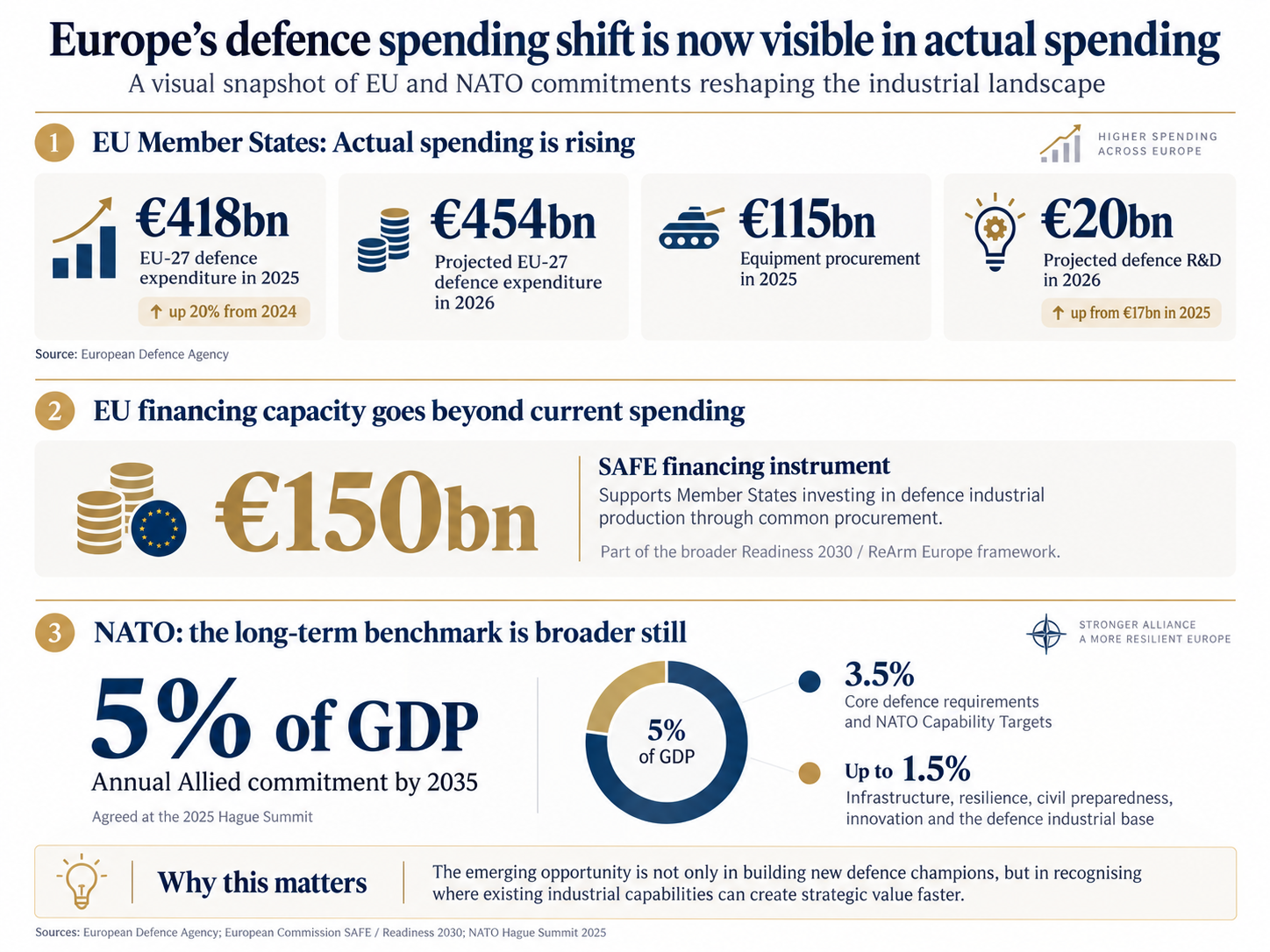
Defence expenditure by the EU’s 27 Member States reached €418 billion in 2025, up 20% from 2024, according to the European Defence Agency. EDA projects approximately €454 billion in 2026. Equipment procurement reached €115 billion, while defence R&D is expected to increase from €17 billion in 2025 to around €20 billion in 2026. European Defence Agency - Defence spending 2025-2026
That is different from the broader Readiness 2030 / ReArm Europe framework, which is intended to enable substantially greater defence investment across Europe. The EU’s SAFE instrument alone establishes €150 billion in financing for Member States investing in defence industrial production through common procurement. European Commission - Future of European Defence / Readiness 2030
At NATO level, the scope is broader still.
At the 2025 Hague Summit, Allies committed to investing 5% of GDP annually by 2035 in defence and defence- and security-related expenditure. At least 3.5% is allocated to core defence requirements and NATO Capability Targets, while up to 1.5% can include critical infrastructure, networks, civil preparedness, resilience, innovation and the defence industrial base. The Hague Summit Declaration 2025
That final category matters. It means the industrial opportunity extends well beyond companies that already describe themselves as defence contractors.
The opportunity does not stop at the defence factory
When defence spending rises, attention naturally goes to ammunition, aircraft, missiles, armoured vehicles and other established military systems. However, readiness depends on a much broader industrial architecture.
Figure 2. Modern readiness depends on a broader industrial architecture
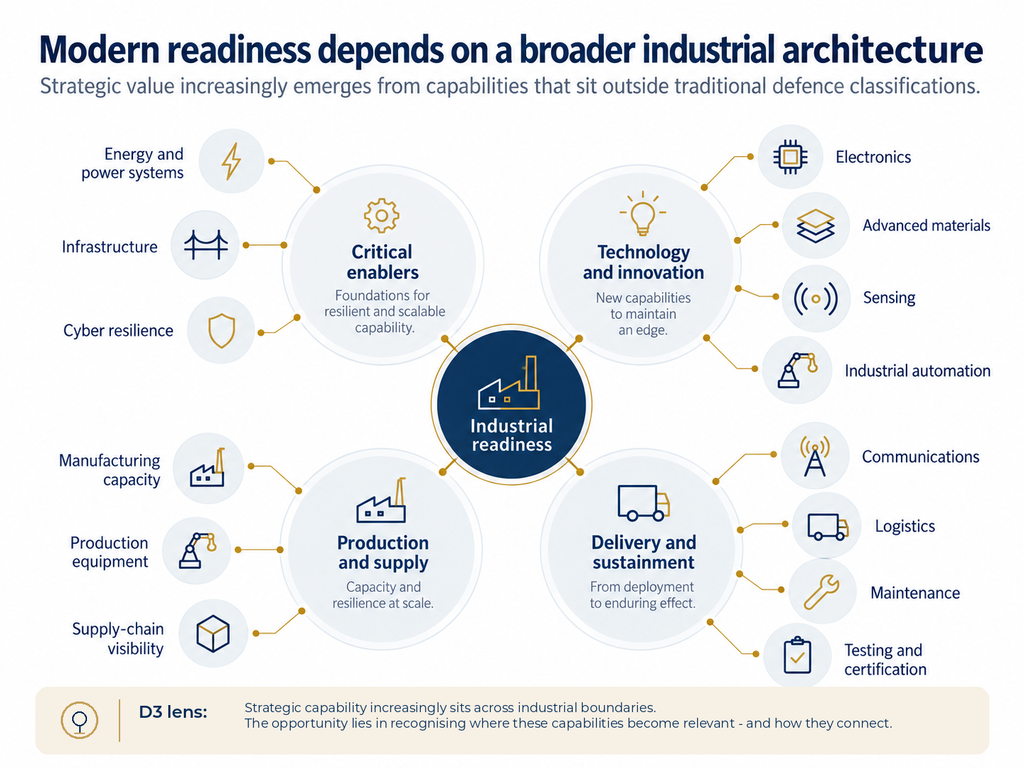
The implication is significant. Europe’s industrial challenge increasingly extends beyond established defence suppliers and into the wider industrial base. Relevant capabilities may already exist in companies serving entirely different markets. The question is whether those capabilities can be identified, recognised and connected to emerging defence and resilience requirements.
The hidden industrial base
Europe cannot strengthen readiness solely by expanding established defence production. NATO itself increasingly points to non-traditional suppliers - including technology companies and medium-sized enterprises - as critical sources of technologies that can address capability shortfalls. Its 2025 Rapid Adoption Action Plan aims, in general, to reduce the journey from an identified need to the acquisition and integration of new technological products to around 24 months.
The direction became even more explicit in 2026. The NATO Innovation Scale-Up Package states that strengthening Allied industrial capacity is not only about expanding traditional defence production lines. It identifies non-traditional suppliers as part of the industrial response and focuses on connecting demand, private capital and manufacturing capacity so that these companies can scale.
One concrete example is the NATO Engine, which connects companies requiring production capacity with manufacturers and civilian factories able to provide it - an indication that industrial readiness increasingly depends on identifying and connecting capabilities across existing networks.
By 16 July 2026, the NATO Support and Procurement Agency reported >840 companies and >100 active opportunities across all 32 Allies on the NATO Engine platform. That does not mean that 840+ companies have qualified defence contracts. It does, however, show that the search for relevant industrial capability is already extending well beyond the traditional defence-industrial base.
That changes the unit of analysis:
"Which companies already possess relevant capabilities but remain outside the traditional defence ecosystem?"
Consider a specialist manufacturer supplying equipment to the chemical or process industry. Its engineering team may have spent decades solving problems involving pressure, corrosive environments, thermal extremes, vibration or long operating cycles. Those capabilities may be relevant somewhere entirely different.
Or consider a company developing autonomous inspection systems for utilities. Its market may be civilian infrastructure. But the underlying combination of sensing, remote operation, navigation and autonomy may also be relevant to ports, critical infrastructure, defence installations or subsea systems.
The same logic can apply to industrial pumps, coatings, batteries, filtration, robotics, composite materials, thermal management, geospatial technology, industrial AI, electronics, maintenance systems and advanced manufacturing.
The strategic question is therefore not simply:
"What products does this company sell today?"
Instead, we ask:
"What capability does the company actually possess - and where is demand for that capability emerging?"
Those are two very different questions.
Strategic value does not always follow industry classifications
Traditional market analysis starts with sectors. A company belongs to an industry. It has competitors. Those competitors sell comparable products to comparable customers. Market size is calculated, growth is forecast and strategy follows. This approach works reasonably well when markets are stable. A company can understand its product extremely well while having limited visibility into the changing strategic value of the capability beneath the product. That is where opportunities are frequently missed.
I call this capability latency: the gap between when a strategically relevant capability already exists and when the market, institutions or investors recognise and mobilise its value.
Figure 3. From market focus to strategic intelligence
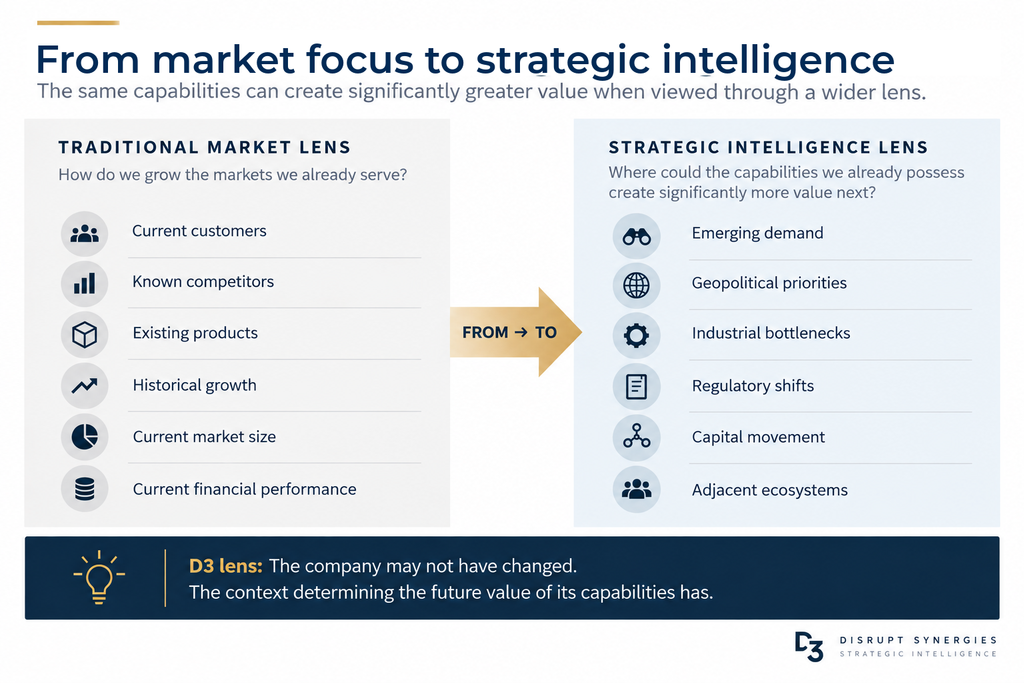
This broader systems view has a long foundation in strategy research. In Harvard Business Review, HBS professors Marco Iansiti and Roy Levien argued in Strategy as Ecology that companies operate within business ecosystems made up of suppliers, distributors, technology providers and other organisations whose performance affects one another. Their point was that competitive performance depends not only on the individual firm, but also on the health and configuration of the wider ecosystem around it.
It becomes less reliable when geopolitics, technology, regulation, capital and industrial policy are moving simultaneously. A capability developed for one market can acquire relevance in another faster than a company’s strategic planning cycle recognises it. This is a good example of how asymmetry is created.
A company can understand its product extremely well while having limited visibility into the changing strategic value of the capability beneath the product. That is where opportunities are frequently missed.
The commercial potential is material. BCG estimated that Europe’s defence build-up could create up to €500 billion of opportunity for non-defence contractors between 2026 and 2029, including approximately €220 billion of new demand outside established defence value chains. But the opportunity comes with friction. BCG also highlights fragmented demand, procurement complexity, changing priorities and significant upfront financing requirements as barriers for companies entering the market.
That distinction matters: a large market does not automatically mean accessible revenue.
A discovery race has started
The competitive advantage may increasingly belong not only to companies that invent faster, but to organisations that identify relevant capability earlier and connect it to demand before the market becomes crowded.
Which companies already possess something useful?
Which civilian technologies can be adapted?
Which manufacturing processes can alleviate a production bottleneck?
Which suppliers could become part of an entirely different industrial stack?
Which capabilities are strategically relevant but commercially invisible?
Finding the company is only the first step.
A technically relevant capability may still face questions around:
- qualification
- procurement
- export controls
- security requirements
- intellectual property
- production scale
- financing
- certification
- supply-chain provenance
- integration partners
- government stakeholders
This creates a second problem.
The emerging competitive advantage is not only technological. It is the ability to identify latent industrial capability and rapidly assemble the customers, capital, partners, regulators and institutions required to deploy it.
The ecosystem may already exist - but not yet around the capability
A company may possess the right technology. A buyer may need it. Capital may be available. Relevant partners, regulators, institutions and technical expertise may already exist across the market. The problem is that these actors are often fragmented, difficult to navigate, or not yet aligned around the specific opportunity.
The company may not know the buyer. The buyer may not know the company. An investor may struggle to determine whether the opportunity is commercially credible. A prime contractor may not yet have visibility into the capability or may be unable to assess qualification risk. Management may not know whether adaptation requires six weeks or three years. The relevant regulatory pathway may exist but remain unclear, while a suitable technology or industrial partner may sit outside the company’s current network.
The result is a recurring paradox:
Demand exists. Capability exists. Capital exists. The ecosystem may also exist. But the connections required to mobilise it have not yet been made.
Figure 4. The ecosystem may already exist - but not yet around the capability
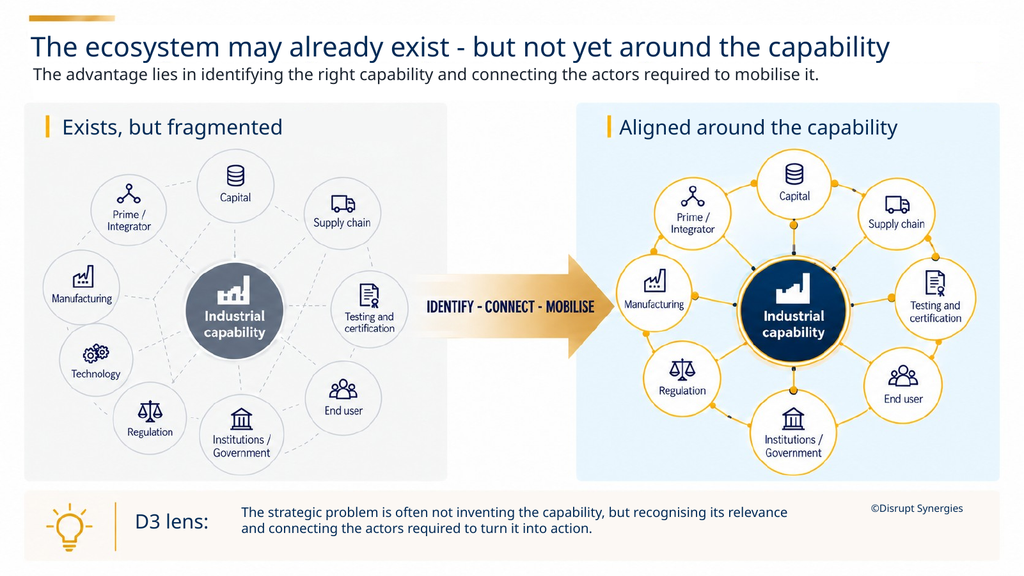
This is where the nature of the strategic problem changes. The challenge is not necessarily to create an entirely new ecosystem, but to identify the relevant actors, understand the dependencies between them and assemble the right configuration around the capability quickly enough to act. The technology may already exist. So may the buyers, capital, partners and institutions. The strategic advantage lies in recognising how they fit together - and connecting them fast enough to turn capability into deployable value.
This changes the question for boards
For industrial boards, one of the traditional strategic questions remains essential:
"How do we increase our share of the markets we already serve?"
There is another question that is becoming increasingly important:
"Where could the capabilities we already possess create significantly more value next?"
Answering that question requires looking beyond the company’s current customers and competitors.
It requires understanding how geopolitical priorities, procurement, industrial policy, regulation, technology, capital allocation and supply-chain vulnerabilities interact. The first meaningful signal may not appear in the company’s CRM. It may appear in a NATO capability requirement, an EU financing instrument, an infrastructure vulnerability, a regulatory shift, a defence-industrial bottleneck or an investment thesis.
By the time the opportunity becomes obvious to everyone, the strongest partnerships may already have formed.
Investors should ask the same question
The same logic applies to industrial owners, family offices, private equity and strategic investors.
An industrial company is usually evaluated through metrics such as:
- revenue
- EBITDA
- customer concentration
- historical growth
- market size
- competitive position
Those remain fundamental. But they may not reveal the full strategic optionality of the company’s capabilities.
Another question becomes relevant:
What does this company know how to do that is becoming more important than its current market suggests?
The answer may reveal:
- adjacent markets
- strategic partnerships
- government demand
- supply-chain importance
- acquisition interest
- new capital requirements
- unidentified regulatory constraints
That does not mean every civilian industrial company should pursue defence. In fact, many should not. The current external environment can materially change the value of a capability before conventional market data fully reflects that change.
From market intelligence to strategic intelligence
Market intelligence asks:
What is happening in our market?
Strategic intelligence asks:
"What is changing outside our market that could alter the future value of our capabilities?"
Figure 5. From signals to strategic intelligence
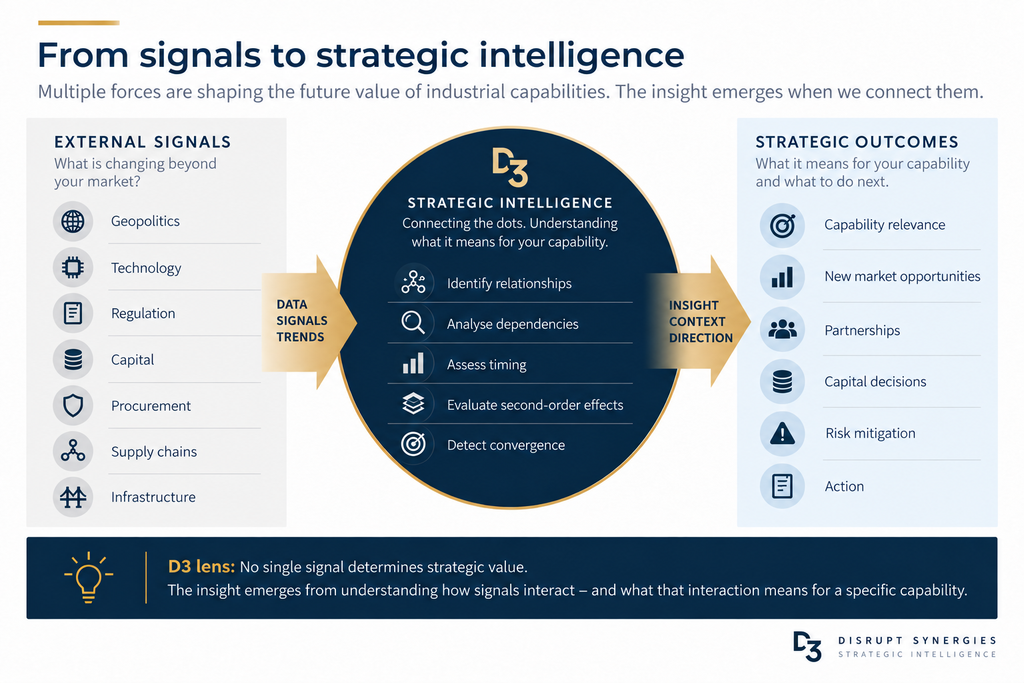
That requires connecting signals that are often analysed separately. A regulatory development may appear insignificant until combined with a procurement requirement. A technology may look niche until connected to an infrastructure vulnerability. A manufacturing company may look ordinary until viewed against a critical supply-chain dependency. An investment may appear unattractive until a new market becomes accessible. The true value lies in understanding the interaction between the signals.
Some of Europe’s most strategic companies may not know it - yet
The next phase of European defence and resilience will undoubtedly produce new technologies, however it will also rediscover existing ones. Some of the companies that become strategically important will not be located inside established defence clusters. They are found in industrial parks, laboratories and manufacturing facilities that have spent decades solving completely different problems. Their technologies already work. Their industrial capabilities already exist. What may be missing is recognition of where that capability now matters, what adaptation may be required, and which customers, partners, capital providers and institutions need to be connected around it to turn relevance into action.
Where Disrupt Synergies fits
Disrupt Synergies examines this intersection: where industrial capability, geopolitics, technology, regulation and capital begin to create new strategic value.
Figure 6. EVRAG™ in Complex Adaptive Systems
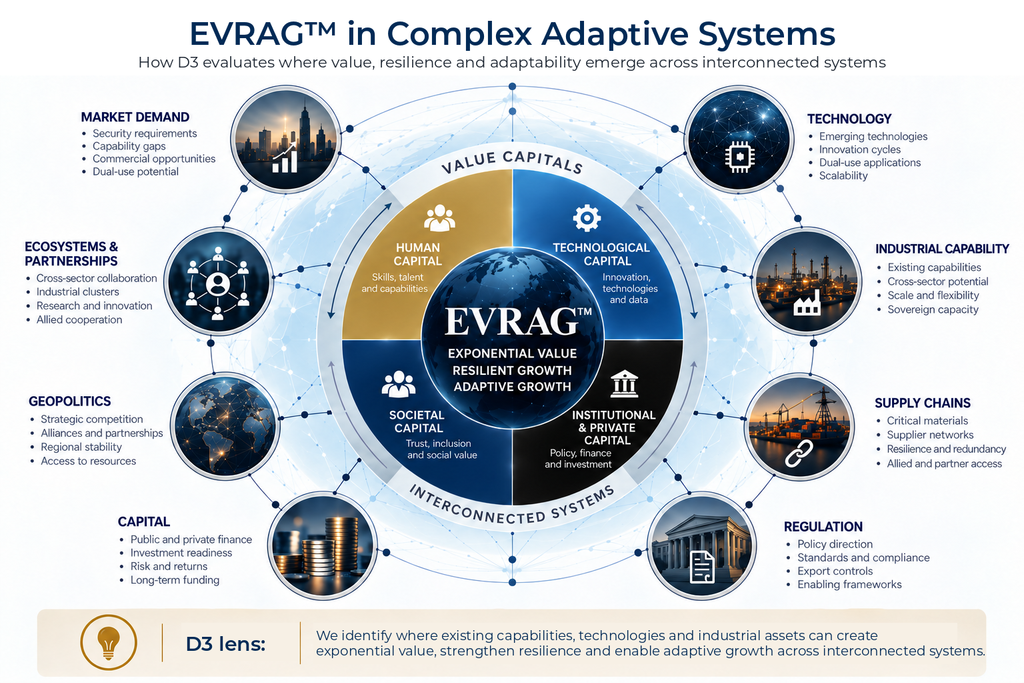
Our work focuses on identifying capabilities whose future relevance may be greater than their current market positioning suggests — and determining what would have to be connected around them to turn that relevance into action. That may involve a new customer, an industrial partner, capital, regulatory navigation, institutional access or entry into an entirely different market.
The starting question is deliberately simple:
Where could an existing capability create significantly greater strategic value next?
Sometimes the missing component is technology. Sometimes it is capital. Sometimes regulation or market access, and sometimes the capability already exists.
What is missing is the connection, and this is where D3 connects the dots.
Johanna Green
Johanna Green is Founder & CEO of Disrupt Synergies, an independent strategic intelligence firm focused on industrial capability, strategic access and emerging markets. Her work examines where structural change creates new strategic value - and where relevant capabilities already exist before markets fully recognise them.
Sources
European Defence Agency — EU Defence Spending 2025–2026, 16 July 2026
EU-27 defence expenditure reached €418 billion in 2025 and is projected to reach €454 billion in 2026. Equipment procurement reached €115 billion, while defence R&D is projected at €20 billion in 2026.
European Defence Agency - Defence Data 2025–2026
European Commission — European Defence / Readiness 2030
The Commission’s Readiness 2030 framework sets out measures to strengthen European defence investment, production and readiness.
European Commission - Future of European Defence
Council of the European Union — SAFE, 27 May 2025
The Council adopted the SAFE regulation establishing a €150 billion EU financial instrument supporting defence industrial investment through common procurement.
Council of the EU - SAFE €150 billion instrument
NATO — The Hague Summit Declaration, 25 June 2025
Allies committed to investing 5% of GDP annually by 2035, including at least 3.5% for core defence requirements and up to 1.5% for broader defence- and security-related investment.
NATO - The Hague Summit Declaration
Iansiti, Marco & Roy Levien — “Strategy as Ecology,” Harvard Business Review, March 2004
Business ecosystems, interdependence and the role of wider networks in company performance.
Strategy as Ecology - Harvard Business Review, March 2004